Chills and Fever on a Schedule, and No Sweat No Matter the Medicine?
A wealthy woman in the prime of her life fell ill with malaria — but this was malaria with a strange rhythm. Every day, at five in the morning, the chills came on; by five in the evening, the fever burned; and at three the next morning, the attack finally released her. One day and one night, she got only a single hour of comfort. The rest of the time she was shaking with cold or burning with heat.
The cause, as Doctor Zhu Danxi read it
Doctor Zhu Danxi (朱丹溪), one of the “Four Great Masters” of Jin-Yuan medicine, questioned her closely. The clue was in how she fell ill: she had caught cold during intimacy with her husband. Exhausted, exposed, her defenses dropped — and the malaria parasite, which can be anywhere, slipped in. This is the classic TCM view of infectious disease: the pathogen is all around us; what decides whether you get sick is your own vitality, your zheng qi (正气, upright qi). When your reserves are strong, the body clears the invader itself. When they are weak, the parasite settles in.
💬 Note from Doctor Luo: Ancient doctors couldn’t see the malaria parasite under a microscope — but they understood the logic perfectly. They focused on how the patient became vulnerable, not just on “killing the bug.” Today we know the parasite itself; the principle of building up the patient’s own strength still holds.
First prescription: strengthen, warm, and push the sweat out
Doctor Zhu Danxi’s approach was to build up her reserves first: ren shen (ginseng) and bai zhu (atractylodes) to strengthen the spleen and replenish qi, plus fu zi (aconite) to warm the kidney yang and open the channels. When yang is sufficient, the theory goes, the body can push the pathogen out through the skin — the classic “sweat as the exit route.”
Days passed. No sweat came. The illness continued exactly as before.
What Doctor Zhu Danxi realized
The great master puzzled over it. The diagnosis felt right. Why wouldn’t the medicine work?
Then he saw it: the cold had lodged deep in the lower body — and the medicine couldn’t reach it. The kidney channel (shen jing) runs down through the legs to the feet. The lower body was blocked with cold, and the yang-warming herbs, swallowed as a decoction, were being absorbed and used up in the middle of the body. The medicine never arrived where it was needed. The channels of the legs were simply closed — so no sweat could break.
The genius move: a basin of herbal foot-soak
Instead of adding more warming herbs to the drink, Doctor Zhu Danxi prescribed a foot bath:
- Cang zhu (atractylodes lancea) — dries dampness
- Chuan xiong (ligusticum) — moves qi and blood
- Peach twig juice — invigorates blood and disperses stasis
These three were simmered into a strong decoction, poured into a basin, and the woman soaked her feet up to the knees, for about the time of one meal. The warm herbal water opened the channels of the lower limbs. The medicine from the herbs now had a clear road to the deepest, coldest part of the body. Circulation returned — she broke into a sweat, and the malaria was gone.
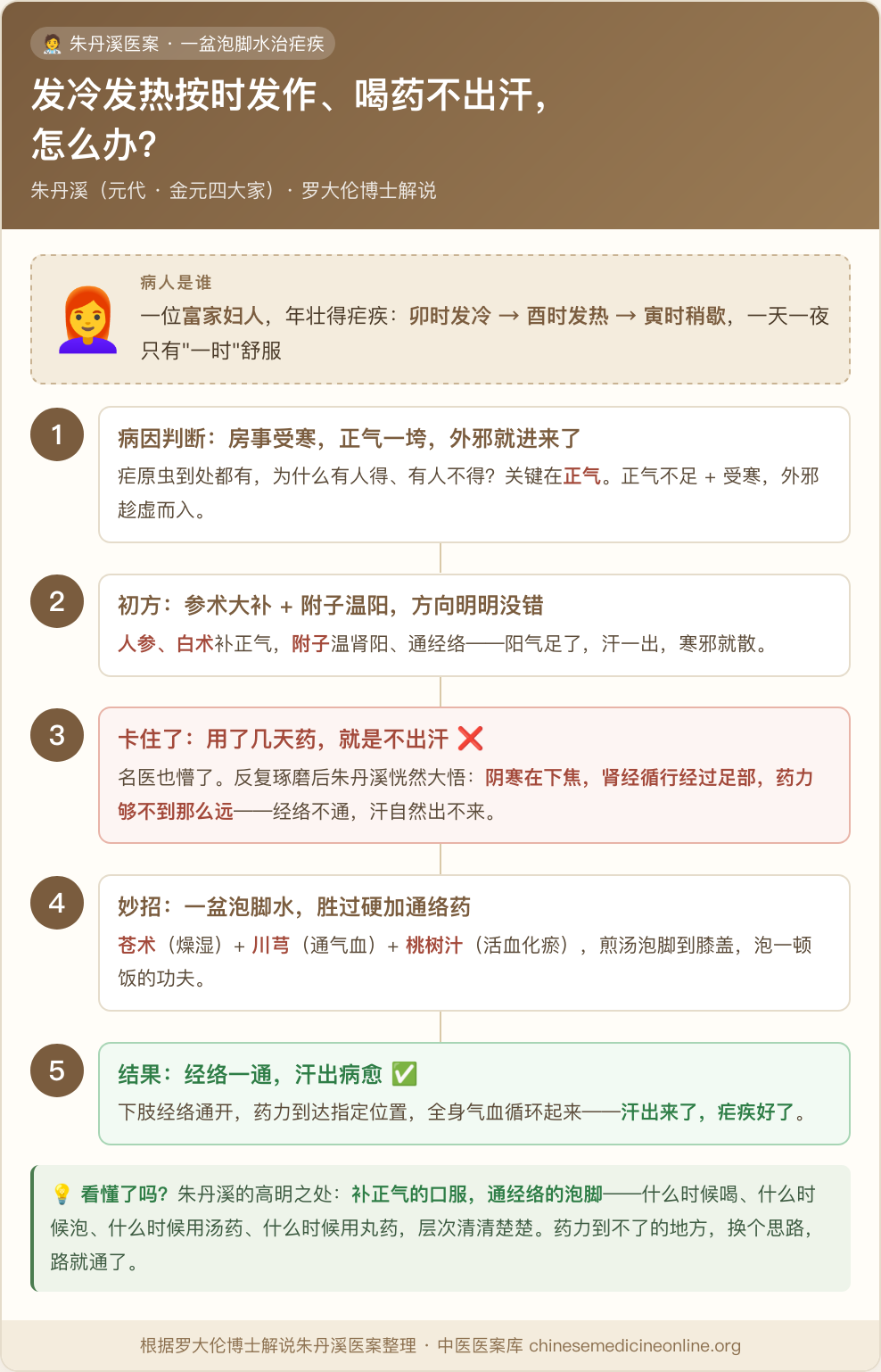
💬 Note from Doctor Luo: Notice how clearly Doctor Zhu Danxi separated the levels of treatment: strengthening medicine goes in by mouth; channel-opening medicine goes on the feet. He didn’t pile everything into one decoction and overload the stomach. The classic text Li Yue Pian Wen (《理瀹骈文》) says external treatment and internal treatment work by the same principle — and this case is a perfect example. When the channels below are blocked, a foot soak can do what an extra dose of herbs cannot.
Why this matters today
Modern research on qinghao (sweet wormwood, 青蒿) — traced back to Ge Hong’s Handbook of Prescriptions for Emergencies (《肘后方》) of the Eastern Jin dynasty — gave the world artemisinin and earned Tu Youyou the Nobel Prize. But Doctor Zhu Danxi’s insight here is a different kind of wisdom: it’s not only about which herb kills the parasite; it’s about how the medicine reaches the place where it needs to act.
This same logic runs through Doctor Luo’s clinical experience:
- Thyroid nodules — patients soak their feet with herbs that move qi and dissolve phlegm; the nodules have been seen to shrink, because the medicines enter the channels through the feet.
- Insomnia — the Chaihu Jia Longgu Muli tang (柴胡加龙骨牡蛎汤, Bupleurum plus Dragon Bone and Oyster Shell) can be used as a foot soak to calm the mind, and it works remarkably well.
- The combination principle — taking strengthening herbs by mouth while soaking the legs with channel-opening herbs is often visibly more effective than swallowing everything as one big combined decoction.
One practical note: it would be a waste to put ginseng in a foot bath — ginseng is precious and should be drunk. But bai zhu, cang zhu and the like, simmered into a soak, can absolutely drain dampness and open the lower body.
Postscript: Doctor Zhu Danxi’s book was the first classic Doctor Luo ever read
Doctor Luo once shared how he came to these ancient texts: he learned Chinese medicine by reading the classics from the very beginning. Growing up, his father was a professor of Chinese literature, and the house was full of classical books — so classical Chinese was as easy for him as reading a newspaper. When he started studying medicine, he went straight to the old masters; Doctor Zhu Danxi’s writings were among the first he ever read. Reading a method like this foot-soak, his reaction was: “Ah — so this is how it’s done. Even the feet can be a medicine path.” Later, the Li Yue Pian Wen confirmed the idea: external and internal treatments follow the same principle.
What to take away: sometimes the cleverest prescription is not a new herb, but a new route. Doctor Zhu Danxi used the legs as a doorway for medicine — and a thousand years later, it still works.