A Lump in Her Belly, Periods Only Every Three Months — What Could It Be?
A woman came to Doctor Xue Lizhai (薛立斋) — the director of the Imperial Medical Institute in the Ming dynasty — with a combination of complaints that modern gynecology would recognize instantly:
- Heat inside and constant thirst
- No appetite
- A lump in the left side of her abdomen, starting the size of a chicken’s egg and growing to about four cun (roughly 5 inches) across
- Periods coming only once every three months
- She was wasting away, and sores had opened on her gums and cheeks
Her pulse was rapid and strong but hollow — and especially so at the left guan position, which corresponds to the liver. (In pulse diagnosis, the left wrist’s middle position reflects the liver; the right reflects the spleen.)
Diagnosis: the liver and spleen were tied in knots
Doctor Xue Lizhai read the case as liver-spleen stagnation (gan pi yu jie, 肝脾郁结). Two forces were at work: anger, frustration and resentment knotting the liver qi, and worry and overthinking exhausting the spleen. The liver channel runs along the sides of the lower abdomen — which is exactly where the lump was. When liver qi can’t move, blood follows and congeals; when the spleen can’t nourish, the body wastes away. The heat and the sores? That was the “fire of the liver” burning upward.
The treatment: one year, three stages, and a very particular clock
Here is where Doctor Xue Lizhai showed his mastery. He did not attack the lump. A lesser doctor would have reached for herbs that “break blood stasis and dissolve masses.” Doctor Xue Lizhai reached, instead, for the patient’s own strength — and he scheduled his medicines like a conductor.
Stage 1 — build the foundation (about two months). An external plaster called awei gao (阿魏膏), made with awei (asafoetida resin) and a dozen supporting herbs — qiang huo, du huo, rou gui, shao yao, chuan shan jia, sheng di huang, da huang, bai zhi, tian ma, hong hua, peach, willow and locust twigs, mu bie zi, and more — was warmed with a flat iron and pressed onto the lump to soften it from outside. Meanwhile, internally: Bu Zhong Yi Qi Tang in the forenoon (to lift yang and strengthen the spleen), and Jiawei Guipi Tang in the afternoon (to nourish the blood and calm the spirit — the “modified” version adds chai hu and zhi zi to clear liver heat). After two months, the liver-fire had retreated a little and the spleen was stronger.
Stage 2 — a small daily cycle (about a month more). Now the prescription became a two-part routine: in the morning, Bu Zhong Yi Qi Tang, taken with Liu Wei Di Huang Wan (six-ingredient rehmannia, the classic kidney-yin pill); in the afternoon, Xiao Yao San (Free and Easy Powder), taken with Gui Pi Wan. Morning lifts and warms; afternoon nourishes and calms. This is the art of “timing the medicine to the clock” — yang moves in the morning, yin rests in the evening.
Stage 3 — now, and only now, clear the fire. When she was strong enough, Doctor Xue Lizhai added Lu Hui Wan (aloe pill) — made with aloe, cinnabar, musk and large saponin pods — specifically to drain the liver-fire that caused the mouth sores and gum ulcers. In the morning, Xiao Yao San washed down the aloe pill; in the afternoon, Gui Pi Tang washed it down.
The result: after roughly a year of this patient, layered regimen, the lump had dissolved and her periods had returned to a normal monthly rhythm.
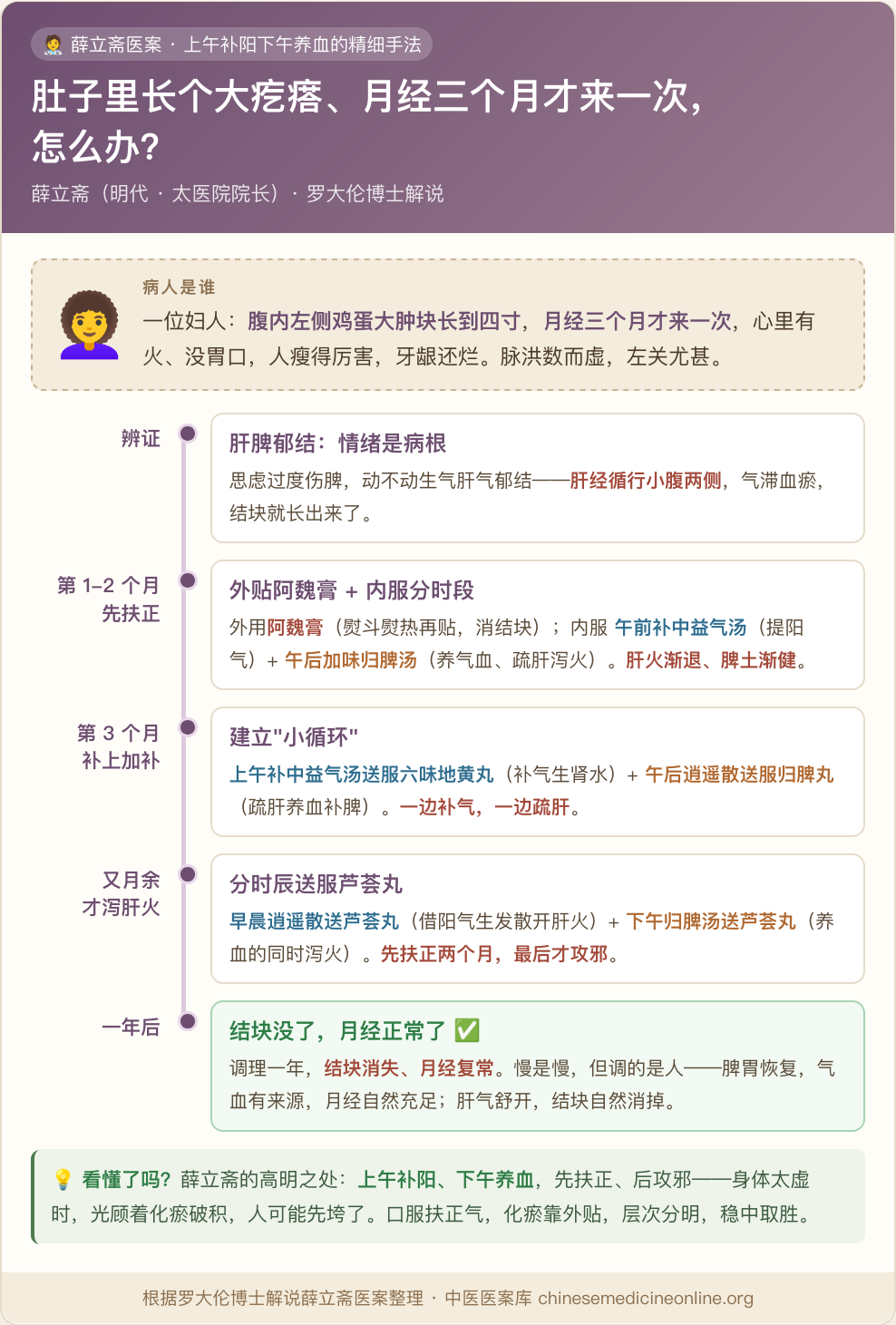
💬 Note from Doctor Luo: Look at the order of operations. Two months of strengthening first. Then a month more of gentle nourishment. Only at the very end, the fire-draining medicine. Why so cautious? Because the woman was already wasting away. If you attack a mass with blood-breaking herbs in a body that weak, you can do real damage — I have seen patients, especially postpartum women, who were given aggressive “blood-moving” treatments and ended up far worse off. Doctor Xue Lizhai’s first question was not “how do I dissolve this lump?” but “how do I keep this person alive and strong while the lump resolves?” The body does most of the healing; the herbs merely support and guide it.
Why Xiao Yao San and the aloe pill were the right tools
- Xiao Yao San — the name literally means “Free and Easy Powder” — is the classic formula for the knot of frustration: it soothes the liver (chai hu), nourishes the blood (dang gui, bai shao), and strengthens the spleen (bai zhu, fu ling). Three jobs in one gentle prescription.
- Lu Hui Wan — aloe is famously bitter and cold; in this formula it targets the fire of the liver that rises to the mouth and gums.
What to take away
Gynecological masses are slow conditions — and this is a slow, careful cure. A year sounds long, until you remember what was accomplished: the lump gone, the periods regular, and the patient’s vitality never sacrificed along the way. Doctor Xue Lizhai treated the person, not just the mass. A hundred years of clinical wisdom in one prescription schedule: morning for yang, afternoon for blood, strengthen first, attack last.