Diarrhea So Bad He Couldn’t Leave His Bed — What Could Possibly Help?
Search keywords: diarrhea / dysentery / belly pain that stays after diarrhea / rush to the toilet / too weak to get up
A frightening case from the start
In autumn of that year, the famous Yuan-dynasty scholar Ye Yi came down with a strange illness — zhi xia, what we today call dysentery. How did it torment him? Belly pain, diarrhea, and pain that stayed after each trip. And when he truly had to go, only a little came out — as if a great deal wanted out but couldn’t pass; the pain remained, the urge never felt satisfied.
💬 Note from Doctor Luo: “Zhi xia” means something stagnating in the gut — very close to today’s dysentery or enteritis. Its hallmark is tenesmus: “li ji” is the urgent need to run to the toilet; “hou zhong” is the persistent feeling of not being finished afterward. This is the classic dysenteric presentation in Chinese medicine.
How bad was the pain? He lost all appetite; couldn’t touch meat or rich food. Day by day he weakened, until he couldn’t get out of bed at all. The most humiliating part — lying on his mat, too weak to reach the privy, he let the diarrhea flow out by itself, let it happen. He wrote it down himself: “listen to it come down on its own.” A dignified great scholar reduced to this — you can see how completely his vital qi had collapsed.
The patient: a great talent who studied alongside Doctor Zhu
Ye Yi was no ordinary man. He was a renowned scholar of his age, and a classmate of Doctor Zhu Danxi — both had studied under the White Cloud Master Xu Qian. When Ye Yi fell ill, Doctor Zhu happened to be in the city; because they were fellow students, he came to treat him.
💬 Note from Doctor Luo: What makes this case precious: the patient himself was a writer and recorded the whole process; Doctor Zhu’s case records also preserve it — two first-person accounts pieced together give later generations a rare, complete record. Just as the poet Yuan Haowen wrote down his own illness when Doctor Li Dongyuan treated him.
Doctor Zhu felt his pulse: the purgative — not yet
Doctor Zhu’s first words: “This is zhi xia. By the book, it calls for Zhang Zhongjing’s Cheng Qi Tang — Major or Minor Purgative Decoction — whose forceful downward action can expel the heat accumulation from the gut.”
You may wonder: he’s already diarrhea-ing that badly, and you’d give him a purgative? Doctor Zhu explained: Cheng Qi Tang treats exactly the pattern of “heat accumulation with the flow,” “dry feces trapped in the intestine” — the stool isn’t truly moving, toxins are piled inside; flush them out completely, and the gut can gradually recover. In TCM this is called “treating a discharge with a discharge” (tong yin tong yong).
💬 Note from Doctor Luo: For dysentery caused by heat toxin, TCM absolutely forbids astringent stopping — especially in the early stage. Never use herbs like poppy husk to clamp down. The diarrhea stops instantly, but the heat toxin gets trapped inside, building worse and worse — the patient can “collapse.” Only at the very end, when little evil qi remains and the diarrhea still won’t stop, do you consider astringents. So “treating a discharge with a discharge” — flush the heat toxin out, and the body can recover.
But Doctor Zhu did not prescribe Cheng Qi Tang right away. He felt the pulse — the qi-kou pulse (right wrist) was extremely deficient; he looked at the man: the frame seemed sturdy, but his face was yellow tinged with white — no blood at all. The vital qi was depleted to the extreme.
💬 Note from Doctor Luo: This is the pivotal move of the whole case. The patient is bedridden, can’t even control his bowels — if you purge him hard right now, the qi scatters and the man could die on the spot. So Doctor Zhu said: “You must bear the suffering a little longer.” He prescribed tonics — ren shen (ginseng), bai zhu (atractylodes), chen pi (tangerine peel), shao yao (peony) — to build qi, strengthen the spleen, ease cramping pain. Ten-some doses.
Ten days of tonics: and the illness seemed “worse”
How did the tonics work? Ye Yi’s own account: not well! The illness seemed to grow worse — more belly pain; his throat felt stuffed with a wad of cotton; at night he moaned and groaned through the hours.
Ye Yi’s heart sank. Zhu Danxi, this famous doctor, our fellow student — how could he be making me worse? Convinced he was beyond saving, he called his two sons to his bedside to say farewell — how to divide the property, how to arrange the funeral. The sons kowtowed and wept. The wailing reached the neighbors, and word spread through the streets: “Ye Yi is done for!” “They say Doctor Zhu Danxi killed him!” Rumors flew from house to house — until Doctor Zhu himself heard the gossip.
💬 Note from Doctor Luo: This passage is pure human nature. The patient suffering, the family in despair, rumors flying — but Doctor Zhu knew this was the body’s normal response to tonics: when a person deficient in vital qi begins to be strengthened, the damp-phlegm garbage inside gets stirred up, and symptoms briefly worsen. So at dawn he hurried over, felt the pulse, and said: “The tonification is about right.”
The turn: two doses of Minor Purgative, and the misery moved downward
Doctor Zhu counted the days — about ten days (jia xun) of tonics — the vital qi should have recovered somewhat. He then brewed a dose of Xiao Cheng Qi Tang (Minor Purgative Decoction) for Ye Yi. Note: Minor, not Major — the rhubarb was not added late, so it simmered long, its active components partially destroyed, and its purging force was far gentler.
The moment the medicine went down, Ye Yi felt the horrible pressure move from the top downward, sinking step by step; his heart settled, the burning restlessness faded. The next day he could drink porridge. After the two doses, the zhi xia was completely cured.
💬 Note from Doctor Luo: Everyone asked: why didn’t you just purge from the start? Two doses and done — why suffer ten days first? Doctor Zhu’s answer was incisive: when I felt the pulse, the qi-kou was extremely deficient — insufficient vital qi. Ye Yi was a scholar who lectured and spoke all day; “those who talk much have deficient middle qi.” He ate well, but the middle qi couldn’t transform and transport it — all that good food had become phlegm accumulation lodged in his body. That was the “physical foundation” of his dysentery. First you must clear out the old and bring in the new — push out the garbage, and the body can recover on its own. His original words: “Without ten days of tonics, how could he have withstood those two doses of Cheng Qi?” — without the tonics, he’d never have survived the purging.
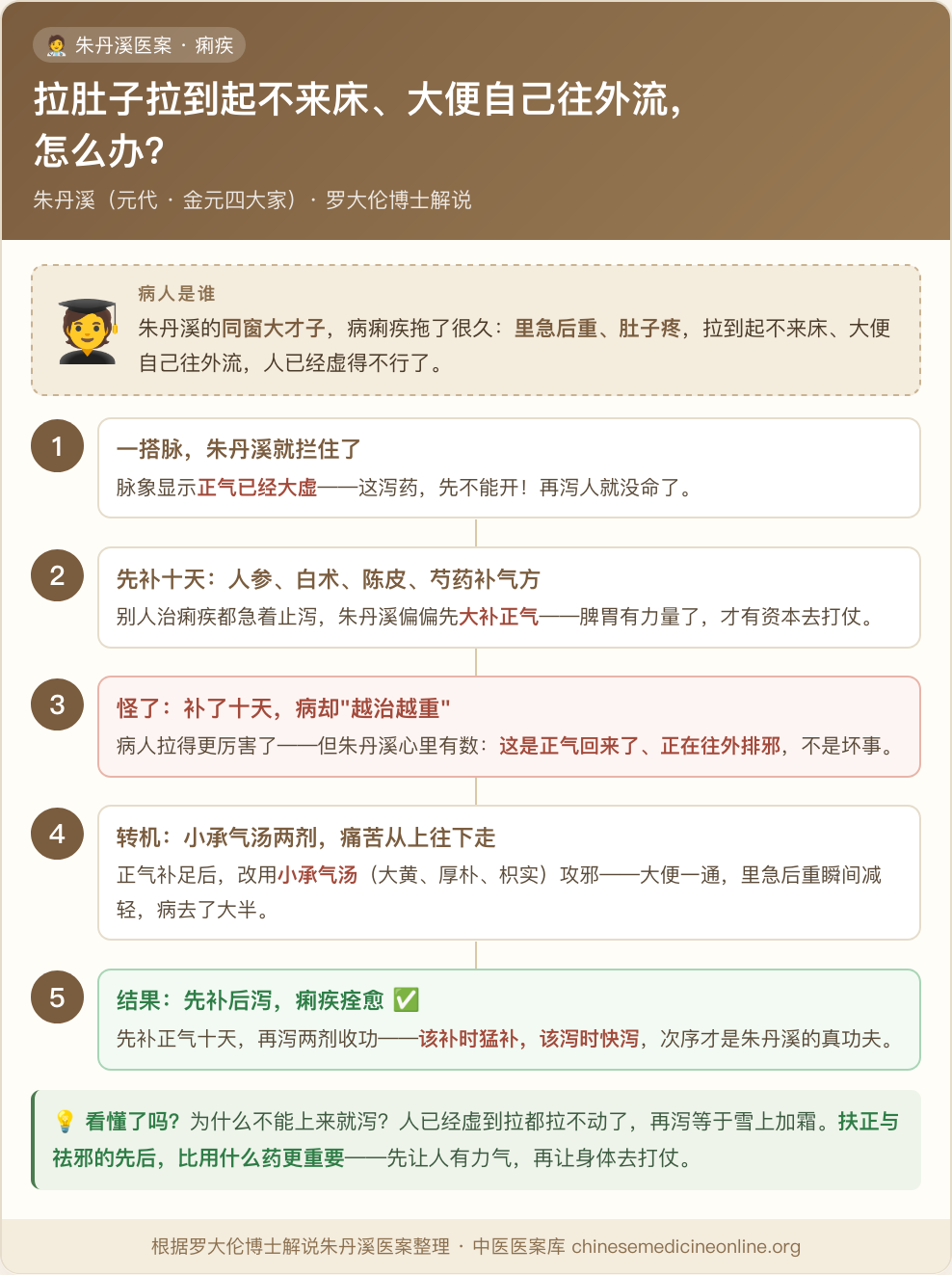
Why not purge immediately? The great art of strengthening and attacking
This approach came from Doctor Zhu’s own teacher — Doctor Luo Zhiti. Luo Zhiti once treated a monk stuffed with phlegm and stagnant blood, yet terribly weak. Luo Zhiti first fed him beef broth, slowly nourishing him; when his qi was strong, he purged once — and the monk recovered. The lesson never left Doctor Zhu.
💬 Note from Doctor Luo: Early in his studies of the Four Great Masters, Doctor Zhu read Zhang Zihe’s doctrine of the three attacking methods — sweating, vomiting, purging — and kept drawing a big question mark: attack everyone, right from the start? Only after studying under Luo Zhiti did he understand — the sturdy-bodied can be attacked; the extremely weak cannot. When vital qi itself lacks the strength to push the pathogen out, a hard attack only wounds the body. It’s like someone with blood stasis taking notoginseng powder to move blood: if the person is very weak, when the qi and blood start moving they can’t handle it — dizziness, collapse. You must first strengthen the qi, then move the blood; only then does the stasis clear.
Later generations also asked: if you need both strengthening and purging, why not mix both kinds of herbs in one prescription? Doctor Zhu’s answer: keep them separate — build the qi fully first, then purge over two days, clean and decisive. Mixed together, the illness drags on and the result is worse — because when the qi is still deficient, a purge can collapse the patient right there in the toilet.
Bonus: “heat” during the strengthening phase — don’t stop the medicine
Doctor Luo adds a warning about a very common modern mistake: side effects during the tonifying phase don’t mean the medicine is wrong. When a body long accustomed to weakness suddenly receives energy, some people can’t fully transform it — more phlegm, swollen gums, bumps. At that point add a digestion-assisting remedy (like Baohe Wan or hawthorn pills) to help absorb the nourishment — and carry on.
💬 Note from Doctor Luo: I once saw an elderly gentleman in terrible shape, near a stroke, exhausted after a dozen steps. A famous “attacking school” doctor in Beijing had been giving him heavy blood-moving, phlegm-clearing, heat-clearing herbs — huge doses of raw gypsum. I took one look: his qi was this depleted, and you’re pouring in raw gypsum? I switched him to Shengxian Tang (Lift the Sunken Decoction) and Bu Zhong Yi Qi Tang — foundation-building formulas — and he said it was like night and day. The disease and the person are two different things; the person is the foundation. When the vital qi is sufficient, drive out the evil and the evil goes; if the vital qi keeps failing while you attack — it cannot be cured. The evil qi came in the first place precisely because the vital qi was deficient at the root.
Ye Yi’s persistence through ten days of tonics is remarkable by today’s standards — many patients take three days, hit a “heat flare-up,” and stop the medicine. The qi never builds, and then the attack can’t work either. So remember: when it’s time to strengthen, hold your nerve. The little setbacks on the road to recovery are often signs the body is getting better.
Based on Doctor Luo Dalun’s lecture on Doctor Zhu Danxi’s case records; original case from the Yuan dynasty (《朱丹溪医案》).