Period Stopped for Three Months and a Lump in the Belly?
Patient search terms: period stopped for three months / periods stopped / hard lump in the belly / lower abdominal lump that hurts when pressed / always worrying
Medical terms: amenorrhea · zheng jia (abdominal mass) · blood stasis accumulating in the lower jiao · liver qi constraint
First, Doctor Zhu Danxi looked at the woman — not at the pulse
The patient in this case was a maidservant, a household worker in a wealthy family. Doctor Zhu Danxi recorded her with unusual care, and the very first words he wrote were eight characters: “色紫稍肥” — her skin was slightly purple, and she was somewhat plump. What does that tell us?
💬 Note from Doctor Luo: Healthy skin should be a warm, rosy yellow-white. When the skin takes on a purplish tinge, it means the qi and blood are not flowing smoothly — there is stagnation inside. When qi and blood are blocked for a long time, the stagnation can brew into heat, and the skin shows that congested purple. Now look at “slightly plump”: plumpness is not the same as strength. A strong, stout person is solid and full of qi; a soft, fleshy person usually carries a lot of dampness and tends toward qi deficiency. One of the trademarks of Doctor Zhu Danxi’s case records is that he first notes the patient’s body type — one glance at the physique, and the general constitutional picture is already set. That is the diagnostic art of wang zhen (望诊), looking at the patient.
Then Doctor Zhu Danxi added four more characters: 性沉多忧 — quiet by nature, prone to worry. She was an introverted soul who spoke little, turned things over in her mind, and sank easily into melancholy.
💬 Note from Doctor Luo: This is another habit of Doctor Zhu Danxi’s — he records the patient’s personality and emotional state. The moment we read “quiet and prone to worry,” we should already think: this woman very likely has liver qi constraint (gan qi bu shu), with the movement of qi jammed up. A personality that cannot open up leads to blockage in the circulation of qi and blood — this is a case of the mind making the body sick, and Doctor Zhu Danxi states it plainly.
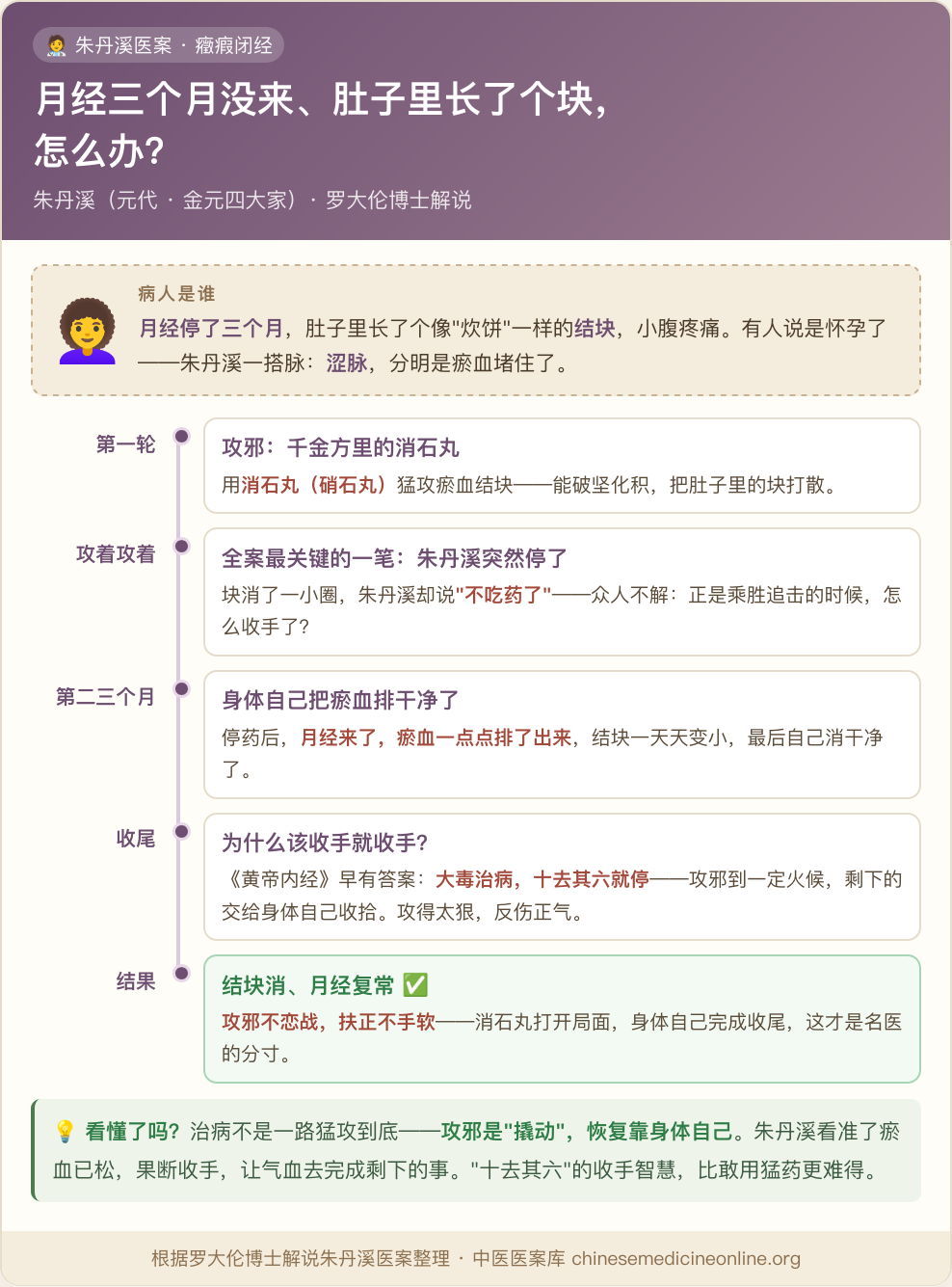
How bad had it become? Three months without a period, and a “steamed bun” growing in the belly
The maidservant was nearly forty — middle-aged. Her complaint: her period had stopped for three months, and in her lower abdomen there was a qi lump. At first it was only chestnut-sized, but it had slowly grown “like a steamed bun” (jian bing) — the sort of small, round wheat cake Wu Dalang sold in the old stories.
When Doctor Zhu Danxi took her pulse: both hands were choppy (se mai). He then asked the patient to press the lump herself — in those days a male doctor did not touch a woman directly, so she pressed her own belly. It hurt badly on pressure, and the lump seemed to stick up about half a cun.
💬 Note from Doctor Luo: A choppy pulse appears again and again in Doctor Zhu Danxi’s case records, because his great specialty was treating stagnation and blockage. When qi and blood cannot circulate, the pulse feels rough and hesitant, like a light knife scraping along bamboo. Here we have a choppy pulse, a painful lump, protruding half a cun — what is it? Blood stasis accumulating in the lower jiao (xia jiao). When a woman’s qi and blood do not flow, they gradually pool in the lower belly. This connects to liver qi constraint: qi and blood congeal, and since the uterus is linked to the liver channel, lumps tend to form in the lower abdomen. With a mass blocking the way, the blood cannot get through — so the period stops. This is an extremely common women’s complaint.
Round one of attack: the Mirabilite Pill from the Thousand Golden Formulas
The strategy: use herbs that soften hardness and scatter masses, herbs that invigorate the blood and even break up blood stasis, paired with purging herbs (like rhubarb) so the old blood could be pushed downward and out. This approach is already laid out in detail in Zhang Zhongjing’s Shang Han Za Bing Lun (Treatise on Cold Damage and Miscellaneous Diseases). In Chinese medicine this is the attacking method (gong fa).
Doctor Zhu Danxi reached for the Xiaoshi Wan (消石丸, Mirabilite Pill) from the Qianjin Fang (《千金方》, Thousand Golden Formulas).
💬 Note from Doctor Luo: The “xiaoshi” in the Mirabilite Pill is the herb mang xiao — mirabilite, the same mineral that appears in Zhang Zhongjing’s Cheng Qi decoctions. Its job is to soften hardness, scatter masses, and purge downward. In the Mirabilite Pill it is paired with rhubarb (da huang). The Qianjin Fang also records a larger version, the Xiaoshi Da Wan, which adds the blood-breaking insects meng chong (gadfly) and shui zhi (leech) — the same lineage as Zhang Zhongjing’s Dahuang Zhechong Wan (rhubarb and ground-beetle pill): break up the stasis, purge the congested heat.
The attacking pill was given four or five times — and then the patient suddenly spoke up. She said: “My nipples have turned black, and fluid is leaking from them. Am I pregnant? Please don’t give me any more purging medicine!”
A master’s pulse diagnosis: a choppy pulse cannot mean pregnancy
Doctor Zhu Danxi, an expert, answered with total certainty: “A choppy pulse has no logic of pregnancy.”
💬 Note from Doctor Luo: When a woman is pregnant, her qi and blood surge — there is a new life inside, and the pulse turns slippery, rolling along like a ball bearing. Your pulse is choppy, faint and rough like a light knife scraping bamboo. There is no way that is pregnancy. This is where Doctor Zhu Danxi’s diagnostic skill shines — one touch of the pulse and he knew: you are not pregnant; you have qi and blood accumulating in the lower abdomen, blood stasis. So let us keep dissolving it.
He gave the Mirabilite Pill for another three to five doses — and then, checking the pulse again, he found it slightly weak.
The most important move in the whole case: in the middle of the attack, Doctor Zhu Danxi suddenly stopped
Pay attention, everyone — this is the difference between a master and an ordinary doctor. An ordinary doctor would hammer away at the mass until it was gone. But the moment Doctor Zhu Danxi felt the pulse turn slightly weak, he thought: this woman’s upright qi really is insufficient. The attacking herbs were draining her — these are fierce medicines.
The medicine must now support the upright qi; once the qi is full, we can attack again. So he told the patient to stop the previous formula, and switched to Siwu Tang (四物汤, Four Substances Decoction) — shu di huang (prepared rehmannia), dang gui (Chinese angelica), chuan xiong (ligusticum) and bai shao (white peony) to nourish the blood — plus bai zhu (atractylodes) to strengthen the spleen and stomach, and chen pi (tangerine peel) to move the qi.
💬 Note from Doctor Luo: Look how complete that prescription is — did he merely nourish the blood? No. He also cared for the yang qi of the spleen and stomach. Anyone who says Doctor Zhu Danxi only knew how to nourish yin and blood is wrong. This formula builds both qi and blood: it nourishes the blood while strengthening the spleen and stomach, because the spleen and stomach are the source of upright qi. How many doses did she take? Thirty — a long, slow, gentle build-up.
How much building was enough? Until the pulse was “complete” — one touch showed a full, unbroken pulse, no deficiency anywhere, qi and blood sufficient (some editions of the text write “pulse full”; the meaning is the same). Doctor Zhu Danxi steered the balance between support and attack entirely by the pulse: qi strong and vigorous again? Good — now we attack. And he used the Mirabilite Pill once more.
The mass shrank by a ring — and Doctor Zhu Danxi said stop
The attacking pill was given another four or five times. Then the woman reported: “My lump seems to have shrunk by one ring.” At that moment Doctor Zhu Danxi did something that astonished everyone — he told her to stop taking medicine altogether.
💬 Note from Doctor Luo: Normally we would press the advantage and dissolve the thing completely, right? Not Doctor Zhu Danxi. Why not? You will understand in a moment.
Half a month passed. Then her period came — and it was painful. She passed half a sheng of black blood — the menstrual blood was black, and inside it were dozens of little grains the size of pepper seeds. What were those? Old, long-buried blood stasis! After that wave, the lump had shrunk by half.
The patient was delighted but also anxious: “Forgive me for saying so — but you’ve had me off the medicine for so long! I only get better when I take medicine!” She came back begging for another prescription.
Doctor Zhu Danxi still would not give her one. Instead he talked her through it: “Don’t be in a hurry. The mass has opened; the stasis has dissolved. We must not attack it again — another attack could wound the upright qi. If your period comes again next month, it should be completely gone.”
The second and third months: her own body flushed the stasis out
The patient went home half-convinced. The second month her period came, and again she passed black blood clots — fewer this time — and the lump shrank another ring. Still not completely gone. She came back for medicine: “You said it would be gone! There’s a little left — just give me the medicine.”
Doctor Zhu Danxi urged patience again: “Don’t rush. Keep to the prohibitions — no overeating, keep your mood cheerful, don’t overwork yourself. Hold to that, and rest assured: this next month it will clear completely.”
And indeed, by the third month, the lump was completely gone.
💬 Note from Doctor Luo: What is the most wonderful thing about this case? Doctor Zhu Danxi understood a special physiological function of women — during menstruation the body runs a kind of “hemolytic mechanism”: it can dissolve blood on its own, and during the period it is especially good at dissolving and flushing out old, long-standing stasis. Experienced old doctors, when they see a woman with deep old stasis (very scanty periods, very dark blood, severe stasis), will deliberately use blood-invigorating herbs during the period window, borrowing that moment to break up the old blood. But this absolutely must not be done for a patient with heavy periods — invigorate the blood further and the bleeding will become unstoppable.
Doctor Zhu Danxi pushed the medicine just far enough — the moment he knew the mass had begun to open, he stopped, and let the body’s own monthly mechanism dissolve and expel the stasis. The upright qi was never wounded, and the pathogen was expelled anyway. This is the kind of subtle strategy that is only possible with a deep understanding of how the body actually works.
Why stop while you’re winning? The Huangdi Neijing had the answer long ago
Why was Doctor Zhu Danxi so careful? He explained it plainly: attacking medicines almost always carry a bias — some of them are outright toxic. When the illness is severe, the attacking drug does its work against the disease, and the disease absorbs the brunt of the drug’s force. But once the pathogen has weakened, if you keep using the same fierce drug, the body itself has to absorb the attack — and the stomach qi (wei qi) gets hurt.
💬 Note from Doctor Luo: This embodies a core teaching of the Huangdi Neijing: “Treat with a strongly toxic medicine and remove six-tenths of the illness; with a moderately toxic medicine, seven-tenths; with a mildly toxic medicine, eight-tenths; with a non-toxic medicine, nine-tenths.” No matter how powerful or how exactly right the medicine is, you never use it to the full — you stop at the right point and let the body finish the recovery itself. Doctor Zhu Danxi also taught that stomach qi is a pure, harmonious qi: it loves grains, meats, vegetables and fruits. Every medicine carries a bias — even ginseng and astragalus have one, let alone attacking drugs. This patient was introverted, and worry had been wearing down her spleen; her spleen and stomach were already weak. If the attacking drugs had gone on and wounded her further, recovery would have cost enormous effort. What a master does is hold the order and the proportion between supporting and attacking exactly right.
The modern disease pattern: eyes only on the illness, forget the upright qi
Through this case, Doctor Luo talks directly about a common failing of modern people — hating the illness so much that we attack it with every drug in sight.
💬 Note from Doctor Luo: I have seen mothers care for a child who catches a cold by piling on five or six cold-fighting medicines at once. Every one of those medicines carries a bias. Will the child’s body absorb all of that? Will it affect growth? Of course it will. This is over-treatment. If Doctor Zhu Danxi saw it, he would scold you for reckless medication. At times like that, support the upright qi instead — give the child some san dou wu mei bai tang (three-bean plum and rock-sugar soup) or shan yao water (Chinese yam water), and the problem usually resolves on its own. People always forget the upright qi and think only of attacking evil: dispelling cold, scattering wind, clearing heat and toxins. The upright qi is the most important thing of all.
Take rheumatic joint pain as another example. Many people see only the disease: the joints hurt, so there must be wind and damp — attack the wind, scatter the damp, drive the pathogen out. They overlook that this person has insufficient upright qi, insufficient qi and blood. Attack alone works for a day or two, then it comes right back. But if you slowly nourish the blood and build the qi, the joints stop hurting on their own — because once the channels are filled with qi and blood, the pathogen has nowhere to hide and simply leaves, and a small amount of wind-scattering herb finishes the job. This is the key to supporting the upright qi.
💬 Note from Doctor Luo: I have long said that Wuji Baifeng Wan (乌鸡白凤丸, Black-bone Chicken Pill) can treat gout, and many colleagues in Chinese medicine have laughed at me. My reasoning: in the past, gout treatment mostly pushed things out — your uric acid is high, your body can’t eliminate its waste, so we help you drain the damp and turbidity; or we tell you to avoid seafood. But if you avoid seafood and your uric acid drops, eat one bite and it’s back up — because your elimination function is broken. When medicine does the excreting for you, that’s the medicine’s function; stop the medicine and it fails again. And heavy purging medicines wound the upright qi — Li Dongyuan was particularly wary of the draining, damp-percolating, downward-pushing class of herbs. Why can’t your body get rid of the waste? Because the upright qi is insufficient. Wuji Baifeng Wan supports the upright qi and nourishes the liver and kidneys; once the qi is full, the body has the capacity to clear its own waste — no drug needed to do the excreting, no strict diet needed, and recovery happens gradually. So for gout patients whose root is deficiency, Wuji Baifeng Wan works remarkably well. When do you use attacking drugs? In an acute flare with heavy damp-heat — then yes, purge, percolate damp, clear heat. But once the flare settles and you see the deficiency underneath, switch to support. When the upright qi is sufficient, the body expels its own garbage — that is the true cure.
In this case, Doctor Zhu Danxi’s skill was at its peak: he cured the patient without wounding her upright qi, and the pathogen was expelled by her own body’s ability. Students of medicine should study his method; ordinary people should study his caution with attacking drugs — don’t let your eyes rest only on the disease, don’t hate the illness so much that you take too many medicines and end up wounding the body instead.
What to take away: attack when the pathogen is strong, support when the qi flags — and when the mass has opened, know when to stand back. A woman’s body has its own monthly mechanism for dissolving old blood; the finest prescription is sometimes the one the doctor doesn’t write.
Retold from the case records of Doctor Zhu Danxi (Yuan dynasty, c. 1300s–1350s), as narrated by Doctor Luo Dalun.