Can’t Swallow, Food Feels Stuck, Slightly Painful Going Down?
💬 A traveler’s search words: I can’t get food down / swallowing feels difficult / something always seems stuck / food seems to take a curved path down / it hurts a little to swallow.
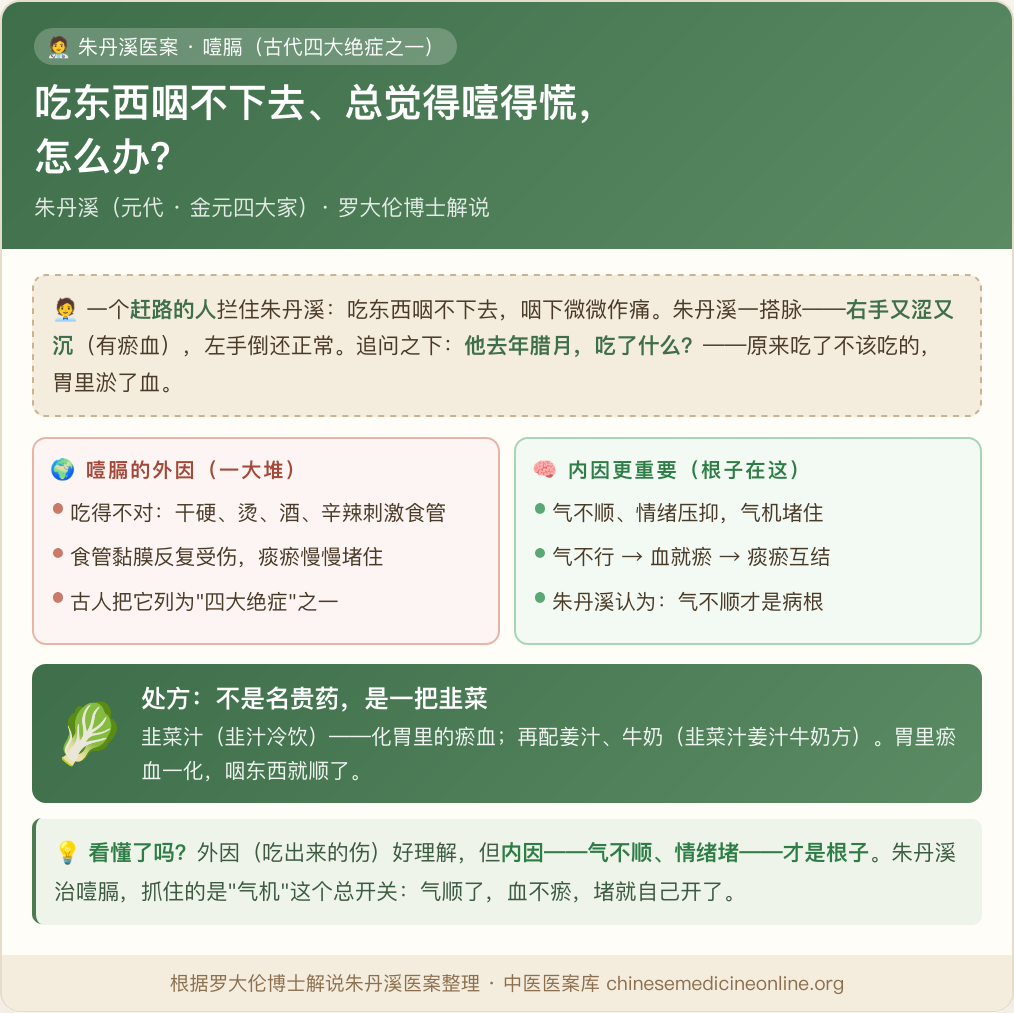
In classical Chinese medicine this is called Ye Ge (噎膈, blockage syndrome) — blood stasis at the stomach entrance, phlegm and blood stasis tangled together, or Fan Wei (翻胃, food turning back up). In the ancient world these were the names for what we would today call esophageal cancer and stomach cancer.
Opening scene: a man on the road stops Doctor Zhu Danxi
One day, Doctor Zhu Danxi was walking along the road when someone hailed him from a distance — it was Wang Zhongyan of Dongyang. Wang hurried up with a big smile: “Ah, Master Zhu! Just the man I wanted to see — I have something I need to ask you.”
💬 Note from Doctor Luo: In ancient times, doctors were stopped in the street by neighbors asking about their ailments — exactly like today. If someone in the family knows medicine, the whole neighborhood will grab them for a word when they meet. Doctor Zhu Danxi’s case records preserve one such charming moment: two men standing in the road, and the consultation begins right there.
Wang Zhongyan explained: “These past few days, when I eat, something feels wrong. When I swallow, the food doesn’t go down straight — it seems to curve and wind its way down. I can feel it myself: it doesn’t pass smoothly, it seems to bend around something at a certain point. And swallowing hurts a little.”
Doctor Zhu Danxi’s interest was piqued: “This is an interesting illness. Come, sit down — let me take your pulse.”
Taking the pulse: choppy and deep on the right, normal on the left
The two men sat down by the roadside, and Doctor Zhu Danxi placed his fingers on the wrist. In that moment, he understood: the right-hand pulse was choppy (se) — choppy means the qi and blood are not flowing smoothly, the road is rough; and when he pressed deeper, the right guan position (the middle position) was especially deep and sunken. The left-hand pulse? Quite normal.
💬 Note from Doctor Luo: In pulse diagnosis, the left hand reflects the heart, liver, and kidney; the right hand reflects the lung, spleen, and life-gate (ming men). The right guan position is precisely the seat of the spleen and stomach. A choppy, deep pulse there means qi and blood are congested in this region — something is blocked. Doctor Zhu Danxi’s conclusion: blood stasis had settled at the entrance of the stomach (the cardia), the stomach was already diseased — and it was not simple blood stasis, but phlegm and blood stasis tangled together. Where does phlegm come from? When qi movement is blocked and stagnation drags on, phlegm is produced; and the making of phlegm is often tied to what we eat.
The follow-up question: “Last lunar twelfth month — what did you eat?”
Doctor Zhu Danxi finished reading the pulse, looked at Wang Zhongyan, and said: “This illness must have come from food. Think carefully — have you eaten anything unsuitable lately?”
Wang thought for a long moment: “No, I’ve eaten exactly as usual.”
Doctor Zhu Danxi did not let it go: “Then let me ask you again — last lunar twelfth month, what did you eat a great deal of?”
At that, Wang remembered: “Last winter it was bitterly cold! Every morning I would drink two or three cups of strong liquor (shao jiu) to warm myself up — I only felt warm once it was down.”
Doctor Zhu Danxi slapped his thigh: “The cause is found!”
💬 Note from Doctor Luo: It all fits. Shao jiu is a fierce, strong liquor — drunk every morning on an empty stomach, cup after cup. The acrid heat of the alcohol repeatedly burned the stomach lining. The esophagus and stomach are delicate mucous membranes; they cannot withstand daily scorching. Over time the membrane is damaged, qi and blood stagnate, and phlegm and blood stasis knot up at the entrance of the stomach. Doctor Zhu Danxi saw through it in one glance: this illness was not caused by one bad meal — it was brewed by drinking strong liquor every single day.
The prescription: not a rare herb — a bunch of leeks
The remedy Doctor Zhu Danxi prescribed is wonderfully ordinary — leek leaves. Wash the leeks, press out the juice — that is the “leek juice” (jiu zhi). How to take it? Drink half a small wine cup, and drink it cold, swallowing it slowly, sip by sip — don’t gulp it down.
Wang Zhongyan was surprised: “That’s all? Simple enough.” He went home, bought leeks, pressed the juice, and followed the instructions.
The result? After about half a jin of leek leaves, the illness was cured.
💬 Note from Doctor Luo: You may wonder — leeks can heal illness? We know that cooked leeks with shrimp warm the yang; that is the property of cooked leeks. But what Doctor Zhu Danxi used here was raw leek juice, and its action is completely different — raw leek is acrid (xin), and acridity disperses. It can spread open the stagnant blood knotted at the entrance of the stomach. This was one of Doctor Zhu Danxi’s favorite moves for this kind of disease, and we’ll look at it in detail below.
Ye Ge: one of the four great terminal diseases of antiquity
At this point, a bit of background is in order. Wang Zhongyan’s “food doesn’t go down smoothly” is called Ye Ge in Chinese medicine — and in ancient times, Ye Ge ranked among the four great terminal diseases!
💬 Note from Doctor Luo: The four great difficult diseases of antiquity were called “wind, consumption, drum, and ge”: wind is stroke (brain wind); consumption is tuberculosis; drum is drum-like abdominal distension and ascites; and ge is Ye Ge, the blockage syndrome. Ye and Ge are actually two degrees of the same disease: ye is when swallowing feels difficult, as if something is always stuck; ge is more severe — at the end, whatever is eaten comes all the way back up, which is called Fan Wei (turning the stomach over). This is the ancient name for stomach cancer — extremely hard to treat, and even Chinese medicine had limited success with it, which is why it was called a terminal disease.
So why can leek juice treat Ye Ge? The ancients discovered that leek juice genuinely works on diseases of the esophagus and stomach caused by blood stasis in the stomach.
“I can’t swallow” — which situation are you in?
Wang Zhongyan’s “difficulty swallowing” could correspond to several different conditions today, and everyone should learn to tell them apart:
💬 Note from Doctor Luo: First, the early warning signs of esophageal cancer and stomach cancer — food feels blocked, the esophagus feels tight, and occasionally something seems to stick. This means the esophagus is beginning to narrow, and it deserves serious vigilance. Second, esophagitis can also cause a choking sensation. Third, Mei He Qi (梅核气, “plum-pit qi”) — when emotions are poor, when stress and anxiety produce a neurotic spasm of the esophagus, it feels as if you can’t swallow, but there is no organic disease at all. So when swallowing becomes difficult, you must find the cause — do the necessary examinations, such as an endoscopy. If it should be checked, check it.
Where cancer comes from: a long list of external factors
So what actually causes esophageal and stomach cancer? Doctor Luo Dalun has summarized it — starting with the external causes, the things we take in:
First, strong liquor. Just like Wang Zhongyan drinking shao jiu every day — alcohol irritates the mucous membranes, and many heavy liquor drinkers end up with esophageal cancer.
Second, scalding-hot food. In some parts of Hebei and Shandong, the incidence of esophageal and stomach cancer is remarkably high — surveys found that people there love piping-hot corn porridge, and they even turn the bowl as they drink to sip from the hottest spot. The repeated burning injures the membrane, and injured tissue is more prone to cancer.
Third, smoked and pickled foods. These foods carry carcinogenic substances of their own.
Fourth, barbecue. National research teams have investigated regions with high rates of esophageal and stomach cancer and found a link to heavy barbecue consumption. South Korea has the highest stomach cancer rate in the world — people grill meat every day, and the grilling process generates carcinogens.
Fifth, moldy food. Spoiled food contains carcinogens and is another major factor.
Sixth, viral infection. Many throat and esophageal cancers today are linked to HPV (human papillomavirus) — normally a sexually transmitted virus, but if oral sex occurs, the virus can travel from the genital region to the mouth and esophagus and cause throat or esophageal cancer. This proportion is very high abroad, and it is rising in China too.
💬 Note from Doctor Luo: These days, barbecue skewers are everywhere in the northeast, and people treat it as culture — “skewers are delicious.” I hate to think how many patients will appear in the years ahead. People don’t understand the principle and wonder how grilled skewers could cause cancer. This is worth studying — and worth taking seriously.
The internal cause matters more: blocked qi is the real root
External causes alone are not enough — the internal cause is the key. What is it? An imbalance in your own qi and blood:
First, insufficient body fluids and yin deficiency — when the fluids dry up, the esophagus and stomach lose their nourishment. Second, yang deficiency with congealed phlegm-dampness. Third — and this is extremely important — poor emotions.
💬 Note from Doctor Luo: Esophageal and stomach cancer are often directly tied to emotion. People with severe liver qi stagnation (yu jie), people who cannot let things go, keep their qi knotted in the chest — and they are prone to throat and esophageal cancer. Stomach cancer is the same: some people hold their anger in day after day; the stomach has been an old, sick stomach for years; it gradually transforms, and finally becomes cancer. The development of a real tumor is extremely complex — but when one causative factor stands out sharply, trouble tends to follow: insufficient upright qi (zheng qi), phlegm-dampness, blood stasis — and eventually a local lesion forms.
Why can leek juice dissolve blood stasis?
Back to Doctor Zhu Danxi’s remedy. What exactly gives leek juice its healing power? This is how he explained it:
💬 Note from Doctor Luo: Doctor Zhu Danxi held that leek juice can transform and disperse blood stasis. Why? Because it is acrid — and acridity disperses. Raw leek carries a pungent dispersing force that can spread open the stagnant “dead blood” knotted at the entrance of the stomach. Note that it must be raw; once cooked, the pungency is gone, and its nature turns to sweet and tonifying of the center — that is a warming, supplementing action, a completely different thing from using it raw. That is why, whenever Doctor Zhu Danxi treated heart pain, or injury from improper eating, or the stasis caused by pent-up rage that left dead blood at the stomach entrance with pain that would not disperse, he had the patient drink leek juice — the acridity is quick and dispersing, and it can dissolve the stagnant blood at the stomach opening.
Doctor Zhu Danxi also often used leek juice for Fan Wei (the “ge” of Ye Ge — the ancient stomach cancer): two cups of leek juice, mixed with ginger juice (juice pressed from fresh ginger), and a little milk. Why these three? Leek juice is warming, ginger juice is hot — together they dissolve the phlegm and stasis; milk is moistening and cool, balancing the formula, so the mixture can be drunk slowly, warm on the way down. That was Doctor Zhu Danxi’s food-therapy formula for stomach cancer. Of course, today stomach cancer is mainly treated with surgery and the like — but such food therapy can serve patients as supportive care.
Li Shizhen recorded it too: leek juice saved an old man with Ye Ge
This method was not unique to Doctor Zhu Danxi. Li Shizhen also recorded a similar case:
💬 Note from Doctor Luo: Li Shizhen recorded an elderly man who developed Ye Ge — whatever he ate came back up, and he felt stabbing pain in the chest. What was done? Leek juice with a tiny bit of salted pickled plum brine (yan mei lu zhi), taken a small sip at a time. Gradually the appetite seemed to open, and he could drink more and more. Then one day the old man suddenly vomited out a great mass of thick, sticky phlegm, and after that, he was well. Whether this severe gastrointestinal illness was truly today’s stomach cancer, we may leave a question mark — but at the time, it genuinely worked for esophageal and stomach blockage caused by blood stasis in the stomach.
Modern research: the ancients’ experience was not groundless
And what about Wang Zhongyan’s feeling that “food curves its way down”? Doctor Luo Dalun explains: this is a nervous sensation. The food does not really take a curved path — rather, one side of the stomach is diseased, the sensation there becomes sensitive, and the body perceives that the two sides respond differently, so it feels as if the food “goes down crooked.” Which is exactly the point: there is blood stasis in the stomach — the stomach is diseased. Doctor Zhu Danxi had him sip leek juice slowly, and it actually straightened this out.
💬 Note from Doctor Luo: People do study leek juice today — not much research, but there are published papers on its blood-stasis-dissolving and anticoagulant effects, and they do find some genuine action in dissolving blood stasis. So the ancients’ experience is not groundless: doctors in ancient China treated patients every day and tried everything; what has been handed down is experience that was tested in practice, and it carries real truth. One more note: Doctor Zhu Danxi also used leeks for upper-body bleeding (vomiting blood, nosebleeds), sometimes combined with boy’s urine (tong bian) — boy’s urine is cool and disperses blood stasis, while leek juice is acrid-warm and disperses blood stasis. Stasis will not disperse without something warm; but when there is heat inside the body, the cool boy’s urine (or, in the stomach cancer formula, milk) is added to balance it. That is the wisdom of ancient food therapy.
Conclusion: prevention is always the most important thing
Wang Zhongyan’s case used the most ordinary of ingredients — leeks — to cure a most extraordinary disease. But the final reminder from Doctor Luo Dalun is this: prevention is always the most important thing.
💬 Note from Doctor Luo: If you love lamb skewers and barbecue every day, take a lesson from this case. If you regularly drink strong liquor, or love scalding-hot porridge and paste, take a lesson too. Let us do our best to remove the causative factors — it will do us all good. Once the disease truly arrives, whether you go to Chinese or Western medicine, treatment takes an enormous effort. This is what Sun Tzu called “subduing the enemy without fighting” (bu zhan er qu ren zhi bing). If a war actually breaks out, killing a thousand of the enemy costs eight hundred of your own — that result is inevitable. Understand the medical principle, prevent early, and protect the health of yourself and your family. That is what matters most.
Compiled from Doctor Luo Dalun’s narration of Doctor Zhu Danxi’s case records (as recorded in the Danxi Xin Fa and related works).
What to take away: swallowing that has become difficult — food seeming to bend around something, a mild sting on the way down, a constant sense of being stuck — is an ancient warning sign that deserves respect. Doctor Zhu Danxi heard that story and asked one brilliant question: what were you drinking every day last winter? Then he answered the disease with the humblest of medicines, raw leek juice, sipped cold. The deeper lesson is the one he and Doctor Luo both stress: look for the daily habits that injure the delicate lining of the esophagus and stomach — strong liquor, scalding food, smoke-cured meat, barbecue, mold — and above all the blocked qi of a mind that cannot let things go. Remove the causes before the illness arrives, because winning without fighting is the only battle truly worth winning.